
 English
 中文简体
中文简体 English
 Русский
 Español
 Português
 Türkçe
 العربية
 Deutsch
 Polski
 Italiano
 Français
 한국어
한국어 ไทย
ไทย Tiếng Việt
 日本語
日本語

















Abstract
XRF elemental analysis is a non-destructive testing technology that realizes qualitative and quantitative analysis based on the wavelength and intensity of characteristic X-rays. It is widely used in RoHS compliance testing, alloy composition analysis, coating thickness measurement and other fields. This paper takes the LISUN EDX‑2A energy dispersive X-ray fluorescence spectrometer as the research object, systematically elaborates the physical mechanism, instrument structure, performance parameters and typical applications of XRF elemental analysis, and verifies the reliability of the method with measured data, so as to provide an efficient testing solution for electronics, materials testing, metallurgy and other industries.
1. Introduction
With the rapid development of electronics, new materials, metallurgy and other industries, the demand for rapid, non-destructive and accurate detection of material elements continues to increase. With the advantages of non-destruction, rapidity, simultaneous multi-element detection and simple sample pretreatment, XRF elemental analysis has become the mainstream technology for RoHS compliance screening, alloy composition identification and coating thickness measurement. LISUN has launched the EDX‑2 series energy dispersive X-ray fluorescence spectrometer, which integrates three functions including RoHS testing, elemental analysis and coating thickness measurement, and can meet multi-scenario detection requirements. Focusing on the principle of XRF elemental analysis, this paper combines the instrument parameters and application data of EDX‑2A to illustrate the practical value of this technology in modern industrial inspection.
2. Basic Principle of XRF Elemental Analysis
The core of XRF elemental analysis is qualitative identification and quantitative determination of characteristic X-rays.
2.1 Excitation Process
The high-energy primary X-rays emitted by the instrument’s X-ray tube irradiate the sample, exciting inner electrons of atoms to escape and form electron holes. Outer electrons transition to fill vacancies and release characteristic X-rays (fluorescent X-rays) corresponding to the atomic energy level difference.
2.2 Basis for Qualitative Analysis
Different elements have different atomic structures and energy level differences, so their characteristic X-ray wavelength/energy is unique, just like the fingerprint of each element. According to Moseley’s law, the wavelength λ of fluorescent X-rays satisfies the relationship with atomic number Z: λ=K (Z−s)⁻², where K and s are constants. Element types can be determined by wavelengths.
2.3 Basis for Quantitative Analysis
The intensity of characteristic X-rays is positively correlated with element content. Under constant excitation conditions, a intensity-concentration calibration curve is established with standard samples. By comparing the spectral line intensity of the sample to be tested, the mass fraction of elements can be calculated to achieve accurate quantification.
In short: qualitative analysis by characteristic wavelength, quantitative analysis by spectral line intensity, which forms the complete logic of XRF elemental analysis.
3. Instrument Structure and Core Parameters of LISUN EDX‑2A
EDX‑2A is a desktop energy dispersive XRF spectrometer under non-vacuum condition. Its core components include X-ray tube, Si-pin detector, sample chamber, automatic control system and special analysis software. With stable hardware and intelligent software, it ensures efficient and reliable XRF elemental analysis.
Table 1 Specification Comparison of LISUN EDX‑2 Series Models
| Parameter | EDX‑2A | EDX‑2AC | EDX‑2AB | EDX‑2ABC | EDX‑2T |
| Type | Desktop non-vacuum | Desktop vacuum | Desktop non-vacuum | Desktop vacuum | Desktop vacuum |
| Weight | 50 kg | 55 kg | 50 kg | 55 kg | 55 kg |
| Testing time | 200 s | 100 s | 200 s | 100 s | 100 s |
| Sample chamber size | 610×320×100 mm | 510×310×120 mm / Vacuum Φ100×70 mm | 610×320×100 mm | 510×310×120 mm Vacuum Φ100×70 mm | 510×310×120 mm Vacuum Φ100×70 mm |
| Test environment | Atmosphere | Vacuum | Atmosphere | Vacuum | Vacuum |
| Detector | Si-pin | SDD | Si-pin | SDD | SDD |
| Resolution | 149 eV | 129 eV | 149 eV | 129 eV | 129 eV |
| Tube voltage/current output | 50 kV/600 μA | 50 kV/600 μA | 50 kV/600 μA | 50 kV/600 μA | 50 kV/600 μA |
| Element analysis range | 2 ppm–99.99% | 2 ppm–99.99% | 2 ppm–99.99% | 2 ppm–99.99% | 2 ppm–99.99% |
| Main functions | RoHS testing | RoHS testing + coating thickness measurement | RoHS testing + alloy analysis | RoHS testing + alloy analysis + coating thickness measurement | RoHS testing + alloy analysis + coating thickness measurement |
| Alloy element range | Undetectable | S–U | Na–U | Na–U | Na–U |
4. Typical Applications of XRF Elemental Analysis on EDX‑2A
4.1 RoHS Hazardous Substance Screening
The EU RoHS Directive restricts hazardous substances including lead, mercury, cadmium, hexavalent chromium, polybrominated biphenyls and polybrominated diphenyl ethers. XRF elemental analysis can rapidly screen Pb, Hg, Cd, Cr and Br, meeting compliance testing requirements for electronic components, plastics and coatings.
Table 2 Limit Standards for RoHS Restricted Substances
| Restricted substance | Limit (ppm) |
| Mercury (Hg) | 1000 |
| Hexavalent chromium (Cr⁶⁺) | 1000 |
| Cadmium (Cd) | 100 |
| Lead (Pb) | 1000 |
| Polybrominated biphenyls (PBBs) | 1000 |
| Polybrominated diphenyl ethers (PBDEs) | 1000 |
In accordance with SJ/T 11365‑2006 standard, EDX‑2A outputs contents of 5 elements within 200 seconds per test, and automatically determines whether the standard is exceeded, which is suitable for batch quality control.
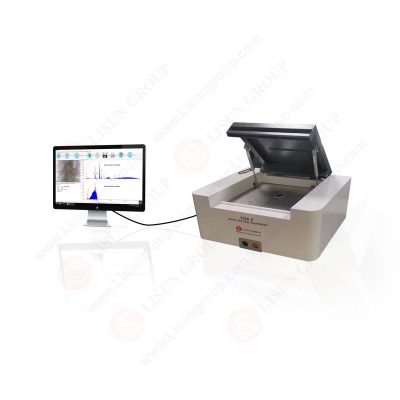
RoHS Testing Equipment EDX-2A
4.2 Alloy Composition Analysis
EDX‑2AB/2ABC/2T supports XRF elemental analysis, covering elements from S(16) to U(92), while EDX‑2T extends to Na(11) to U(92). It is applicable to composition analysis and grade identification of stainless steel, copper alloy, aluminum alloy, precious metals and other materials. The non-destructive and rapid detection without digestion greatly improves recycling and production efficiency.
4.3 Coating Thickness Measurement
Vacuum models EDX‑2AC/2ABC/2T adopt XRF elemental analysis technology to accurately measure single/multi-layer coating thickness. It is compatible with gold plating, nickel plating, zinc plating, copper-nickel-chromium and other systems, providing absolute value data to meet quality control requirements of electroplating, hardware and electronics industries.
5. Advantages of EDX‑2A Instrument
• Non-destructive and rapid: No damage to samples, about 200 seconds per sample, simultaneous output of multi-element data, greatly improving detection efficiency.
• Wide sample adaptability: Compatible with solids, powders and liquids, without complex pretreatment and low operation threshold.
• Reliable core components: Imported high-quality components, Si-pin detector with 149 eV resolution and excellent stability.
• Intelligent and user-friendly: High-definition camera positioning, automatic testing, overcurrent & short-circuit protection, standard samples and calibration certificates included, and one-click report generation.
• Multi-function integrated design: Combined functions of RoHS testing, elemental analysis and coating thickness measurement, reducing equipment investment and operation costs for enterprises.
6. Conclusion and Prospect
Taking qualitative analysis by characteristic wavelength and quantitative analysis by spectral line intensity as the core, XRF elemental analysis is a key technology for modern industrial element detection. LISUN EDX‑2A energy dispersive X-ray fluorescence spectrometer realizes engineering application of this principle, integrating RoHS screening, alloy analysis and coating thickness measurement. With advantages of rapidity, non-destruction, accuracy and ease of use, it is widely applied in electronics, materials, metallurgy, environmental protection and other fields.
In the future, with the integration and development of detectors, algorithms and artificial intelligence, XRF elemental analysis will evolve towards higher resolution, faster speed, lighter element detection and more intelligent automatic grading, providing stronger support for material research and development, quality control and green compliance.