 English
 中文简体
中文简体 English
 Русский
 Español
 Português
 Türkçe
 العربية
 Deutsch
 Polski
 Italiano
 Français
 한국어
한국어 ไทย
ไทย Tiếng Việt
 日本語
日本語




What is the Surge Test?
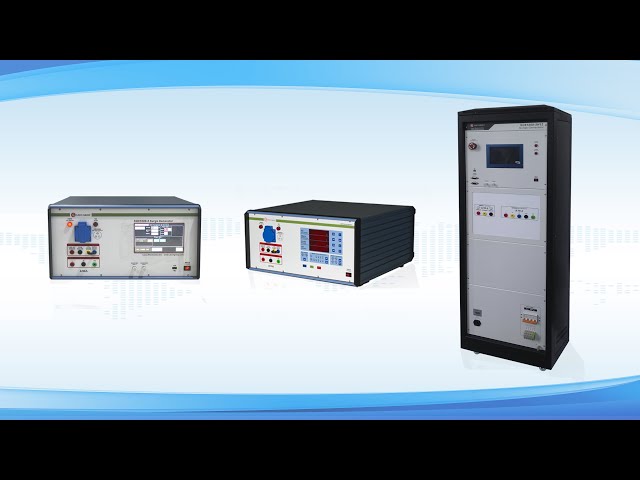
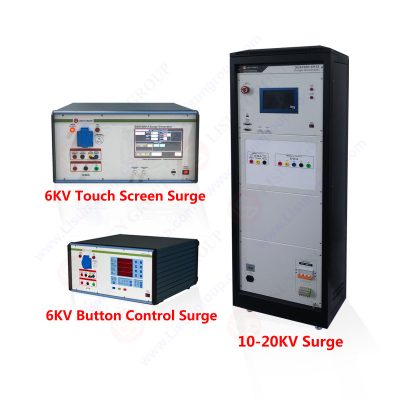
The surge (impact) immunity test is to simulate the effects of lightning strikes (indirect lightning) in nature and voltage changes caused by large-scale switch switching in power supply lines on power supply lines and communication lines. The surge test specifies two waveforms (1.2/50 μs and 10/700 μs for communication waves), with amplitudes ranging from 0.5kV to 4kV, with particularly high energy, which may have destructive effects on the EUT. 10/700μs (commonly known as communication wave) is suitable for long-distance symmetrical communication ports, and 1.2/50μs is suitable for power line ports and other signal line ports. The SG61000-5 surge generator provides a common basis for evaluating the resistance of power cords and internal connectors of different equipment to high energy transient interference caused by natural lightning surge induction and large capacity load switching.
surge generator
Level 1: Better protected environment, such as the control room of a factory or power station.
Level 2: A certain protected environment, such as a factory without strong interference.
Level 3: Ordinary electromagnetic disturbance environment, no special installation requirements are specified for equipment, such as commonly installed cable networks, industrial workplaces and substations.
Level 4: Severely harassed environments, such as civil overhead lines, unprotected high-voltage substations.
Class X: Special class, determined after consultation between the user and the manufacturer. Which level to choose for a specific product is generally determined by the product standard.
a) Normal performance within the limits specified by the manufacturer, the entrusting party or the purchaser
b) The function or performance is temporarily lost or degraded, but can recover by itself after the disturbance ceases, without operator intervention;
c) Temporary loss or reduction of function or performance, but recovery by operator intervention;
d) Unrecoverable loss of function or performance degradation due to damage to device hardware or software, or data loss.
Investigate the damage of the tested interface and the degradation of the device performance after the user line interface is impacted by the surge voltage during the actual use of the device. Index requirements: The surge test of the telephone port is divided into two types: type A and type B.
a) Waveform. Differential mode interference: voltage wave: 10/560, current wave: 10/560. Common mode interference: voltage wave: 10/160, current wave: 10/160.
b) Test level: differential mode: the voltage is less than 800V, and the current is less than 100A. Common mode: the voltage is less than 1500V, the current is less than 200A
c) Test port: differential mode: tip—ring; tip-1—ring-1; for a 4-wire cable for single communication, tip—ring-1, ring—tip-1. Common Mode: tip-ring and tip-1 – ring-1 to ground, or to other cables (screwed together) connected to uncertified equipment.
d) Test state: All states of the equipment that may affect the requirements of this standard shall be tested. If the device status cannot be obtained by normal power-up, manual intervention is required; ports without surge (including telephone ports, auxiliary ports, and ports connected to unauthenticated devices) should be properly terminated and in normal use state; if the primary power supply of the device allows plugging and unplugging, the device must be tested both with the power cord and with the power cord disconnected.
e) The criterion allows open circuit or short circuit to ground in the safety circuit, but in this failure mode, it is ensured that the user cannot use the device, or the device has obvious failure indication (such as an alarm), and it needs to be removed from the network immediately. Disconnected or in need of repair. After the safety circuit has been repaired, device performance and function return to normal.
a) Waveform. Differential mode: voltage wave: 9/720, current wave: 5/320. Common mode: voltage wave: 9/720, current wave: 5/320.
b) Test level: differential mode: the voltage is less than 1000V, and the current is less than 25A. Common mode: the voltage is less than 1500V, the current is less than 37.5A
c) Test port: differential mode: tip—ring; tip-1—ring-1; for a 4-wire cable for single communication, tip—ring-1, ring—tip-1. Common Mode: tip-ring and tip-1 – ring-1 to ground, or to other cables (screwed together) connected to uncertified equipment.
d) Test state: All states of the equipment that may affect the requirements of this standard shall be tested. If the device status cannot be obtained by normal power-up, manual intervention is required; ports without surge (including telephone ports, auxiliary ports, and ports connected to unauthenticated devices) should be properly terminated and in normal use state; if the primary power supply of the device allows plugging and unplugging, the device must be tested both with the power cord and with the power cord disconnected.
e) Criterion equipment must be able to withstand the surge energy of type B, and cannot cause permanent open circuit or short circuit of the interface circuit, and cannot cause equipment damage that affects the standard requirements.
Type B: The certified terminal equipment and protection circuits must be able to withstand the surge energy of type B, and cannot cause permanent open or short circuit of the interface circuit, and cannot cause damage to the equipment that affects the requirements of this standard.
Lisun Instruments Limited was found by LISUN GROUP in 2003. LISUN quality system has been strictly certified by ISO9001:2015. As a CIE Membership, LISUN products are designed based on CIE, IEC and other international or national standards. All products passed CE certificate and authenticated by the third party lab.
Our main products are Goniophotometer, Integrating Sphere, Spectroradiometer, Surge Generator, ESD Simulator Guns, EMI Receiver, EMC Test Equipment, Electrical Safety Tester, Environmental Chamber, Temperature Chamber, Climate Chamber, Thermal Chamber, Salt Spray Test, Dust Test Chamber, Waterproof Test, RoHS Test (EDXRF), Glow Wire Test and Needle Flame Test.
Please feel free to contact us if you need any support.
Tech Dep: Service@Lisungroup.com, Cell/WhatsApp:+8615317907381
Sales Dep: Sales@Lisungroup.com, Cell/WhatsApp:+8618117273997